
At first glance, Clash de Cartier doesn’t look quite like the Cartier you already know. Launched in 2019, the collection is all about contrast: rounded beads with pointed studs, softness with structure, and traditional fine jewellery with a rebellious finish.
That’s exactly what makes you look at the collection a bit more closely. Clash has since expanded across rings, bracelets, necklaces, and earrings, with versions in yellow, rose and white gold, as well as diamond-set and coloured-stone designs. Cartier’s current collection includes more than 20 Clash rings alone.
According to Cartier CEO Cyrille Vigneron, Clash’s early success was “far beyond” the Maison’s expectations, to the point that Cartier had to rethink its entire production process to allow for more capacity.
That’s why we find Clash de Cartier so interesting. The collection is only a few years old but it’s already established an iconic identity of its own. Keep reading, and we’ll tell you all about what makes Clash de Cartier different.
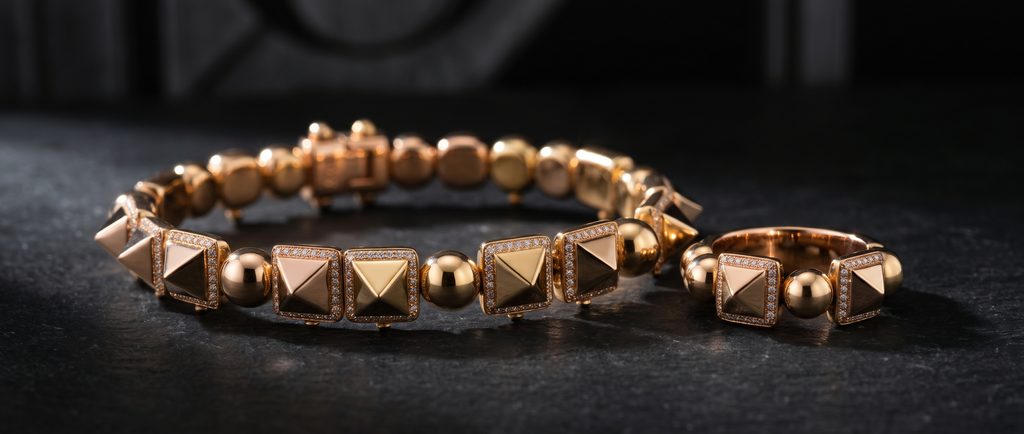
Cartier took a calculated risk with its Clash de Cartier collection. It’s just rebellious enough to turn heads, but still features all the finish and precision you’d expect from one of the great Parisian maisons.
The brand has a history of using a different signature motif for each collection. For Love, it was the iconic screw, while their Trinity collection featured three interlocking bands.
However, Clash is a little different. It doesn’t have a notable motif, so its identity more so revolves around the jewellery’s architecture rather than a single emblem. Here are three visuals we noticed in the Clash de Cartier collection.
Where Love is built around a single, instantly recognisable screw motif and Trinity expresses symbolism through three interlocking bands, Clash is more tactile and kinetic. Its identity comes from surface, volume and movement rather than a single emblem.
Cartier builds the collection around three visual codes:
According to Cartier, these visual parts come together to form a “singular geometric moving mesh.” We found that phrasing interesting because it shows just how intentional each choice was. Each element is arranged to catch light differently as the piece moves, so the effect shifts between hard-edged geometry and a soft, almost fabric-like feel.
Plus, we can see that contrast is a huge theme with this collection, especially considering the name itself. Here, “clash” refers to the deliberate meeting of opposites: sharp studs vs. rounded beads, classic goldsmithing vs. subversive silhouettes, and so on.
It wouldn’t do this collection justice to simply call it “edgy Cartier.” At a closer look, you’ll truly appreciate how the brand has disciplined these rebellious details using the fine craftsmanship they’re known for.
If that seems like your type of jewellery, you’re in luck because it’s now a complete collection. In the UK, the Clash collection has 58 items, while in the US, the Clash bracelet category alone has 17 pieces!
As we said, the main idea behind Clash de Cartier is “contrast.” Cartier took elements that typically compete with each other visually and made it work beautifully. For instance, the rounded beads soften the aggressiveness of the pointed studs and picots, while square clous de Paris add a more architectural, graphic edge.
The goal was to create a geometric mesh that makes it look less like jewellery and more like fabric. It’s all about movement, which is why Cartier introduced flexible bracelets in this collection to show off its fluidity and light refractions.
The brand introduced Clash de Cartier in 2019, so it’s still a fairly modern “icon.” Still, it doesn’t try to plagiarize from Cartier’s older icons to replicate their success. Clash is an entirely new face of Cartier; more textural, more modular, and deliberately more ambiguous than ever.
If you’re looking for a simple entry point into the Clash collection, we recommend going for the Clash de Cartier ring. You still get the signature interplay of studs, polished beads, and square clous, but on a compact scale that’s easy to wear every day.
Luckily, there’s more than just one iconic ring in the collection for you to choose from. It features small, medium, and extra-large rings, plus single-row and double-row options. The small 18K rose-gold model, for example, measures 6.4 mm wide, so it’s safe to say that each Clash de Cartier ring is made to stand out:
The Clash collection features rings like:
Now, let’s talk about how to style it.
For everyday wear, a plain gold Clash de Cartier ring works best. It’s simple, versatile, and lightweight. But if you’re going out for a more formal event, we recommend going for one with Pavé diamonds.
For days when you’re feeling extra bold, you can even pair two contrasting Clash rings, such as rose and white gold, then keep any extra bands smooth and simple. Just don’t track multiple heavily textured rings together as Clash already has enough geometry on its own.
It’s clear that Clash de Cartier bracelets got the most attention to detail when making the collection. They’re so simple, but it’s where the design truly comes alive. The rings are a more concentrated version of the design, while the bracelet gives it more room to breathe. It’s the visually animated sister of the Love bracelet.
The great part is that you get to choose from rigid and flexible Clash bracelets. Both options show off different aspects of the design philosophy, so we honestly recommend getting one of each.
A rigid model has a stronger silhouette. For instance, the Clash de Cartier bracelet, medium model in yellow gold, has an 8 mm width. That’s enough to still get attention when worn beside a watch or even solo, without looking too much like a cuff.
If you want to show off the iconic fluidity of the Clash collection, the flexible bracelets are obviously the better choice. These bracelets are designed to follow the wrist rather than act as a bangle.
We’d say the double Clash de Cartier flexible bracelet is the most dramatic choice here, as it’s paved in rose gold, 9.2 mm wide, and set with 512 diamonds totalling 1.81 carats. Now that’s how you make a statement!
If you’re more preferential to traditional Cartier jewellery, get a Clash de Cartier bracelet in yellow gold. It makes the rounded beads look richer, the picot studs more pronounced, and the square clous get a crisp, sunlit finish. The small model is 6.4 mm wide, while the medium one expands to 8 mm, so you can choose between everyday and formal wear.
In the UK, the Clash bracelet category has 15 items, including yellow, rose, and white gold, as well as double-row, larger-volume, and diamond-set versions. For instance, the extra-large onyx model with diamonds combines rose gold, onyx, and 277 diamonds totalling 3.52 carats in a 12.2 mm-wide format.
The Clash de Cartier necklace gives the same studs, beads, and square clous carrés a longer, more fluid visual line. It’s not as concentrated as the ring and more flexible than the bracelet, which shines even more light on the beautiful contrast.
Cartier describes the necklace as a “flexible expression of the Clash mesh.’ Instead of opting for a completely fixed collar shape, the brand went for a soft chain that follows the collarbone and moves with the body.
Here are the variations available in the current Clash necklace family:
To do the necklace justice, we recommend wearing it with an open neckline, a crisp white shirt left slightly undone, or a simple black dress. Keep earrings and rings simple so the necklace can still be the focal point.
The Clash de Cartier earrings are one of the easiest ways to wear the collection without committing to a wide bracelet or necklace. They place Cartier’s signature tension exactly where it has the most impact: around the face.
There’s a little more variety in the earrings section as compared to the rings, necklaces, and bracelets. You get to choose between the hoop earrings, which also have tons of variations, and the dangly “multi-wear” option.
The Clash de Cartier hoop earrings are available in mini and medium versions. There’s also the choice between getting them in plain gold or set with 14 brilliant-cut diamonds in each earring, totalling 0.41 carats per pair. Not only can you pick between the metals (yellow, rose, and white gold), but there are also four accent gemstone variations: black onyx, red agate, green agate, and pink chalcedony.
You get the same choices in metals and accent colours for the multi-wear dangling earrings. However, the size range is a little wider, as Cartier also offers large and extra-large Clash multi-wear earrings.
For a first Clash purchase, earrings make perfect sense: they frame the face beautifully and can be worn with almost anything. If you’re wearing a casual outfit, go for mini hoops in yellow gold. For evening, use diamond-set medium hoops or the onyx multi-wear design with minimal neckwear.
Can a collection launched in 2019 already be called an icon? Not exactly, but we’d say Clash de Cartier has presented its case quite convincingly.
Icon status isn’t a matter of sales or social-media visibility. In jewellery, it normally requires a recognisable visual identity without relying on a logo, cultural relevance, the ability to evolve, and enough longevity for the design to outlast a quick trend.
Clash already has the first ingredient in abundance. The picot studs, polished beads and square clous carrés are identifiable all across the collection in different proportions. Cyrille Vigneron, Cartier’s then-president and CEO, told Vogue Business that Clash had become an identifiable product and that it could become an icon for another generation.
The only open question is time. Trinity has been in circulation since 1924, while Juste un Clou was released in 1971, so they have decades of recognition as “icons” – something Clash can’t claim just yet.
Still, it’s very clear that the collection has all the potential to keep expanding in the future and eventually join Cartier’s museum of icons.
It’s safe to say Clash de Cartier has earned its place in the jewellery scene and is here to stay. The collection did something the Maison does not often do: it breaks from its softer, more traditional designs the brand is known for, but not by abandoning its craftsmanship and goldsmithing.
Clash de Cartier’s beads, studs, and geometric shapes give its rings, bracelets, necklaces, and earrings a very unique identity that we’ve grown to love. Plus, with all the different metals, diamonds, and coloured stones available, it’s easy to find a version that suits you best.
If you’re hoping to get your dream Clash piece today, look no further. If you buy it pre-owned, you can even get it at a fraction of the retail price without compromising on condition or authenticity! Take a look at Love Luxury’s collection of pre-loved Cartier jewellery.
 Know Your Jewellery: Cartier
 How To Sell Your Cartier Love Bracelet
 Cartier Jewellery That Is Worth the Price
 Cartier’s Most Famous Jewellery Pieces That Every Woman Wants
 Luxury Cartier Items that Are Worth the Price
 From Paris with Love: The History Behind Cartier
 5 Luxury Jewellery Pieces That Are Worth the Investment