
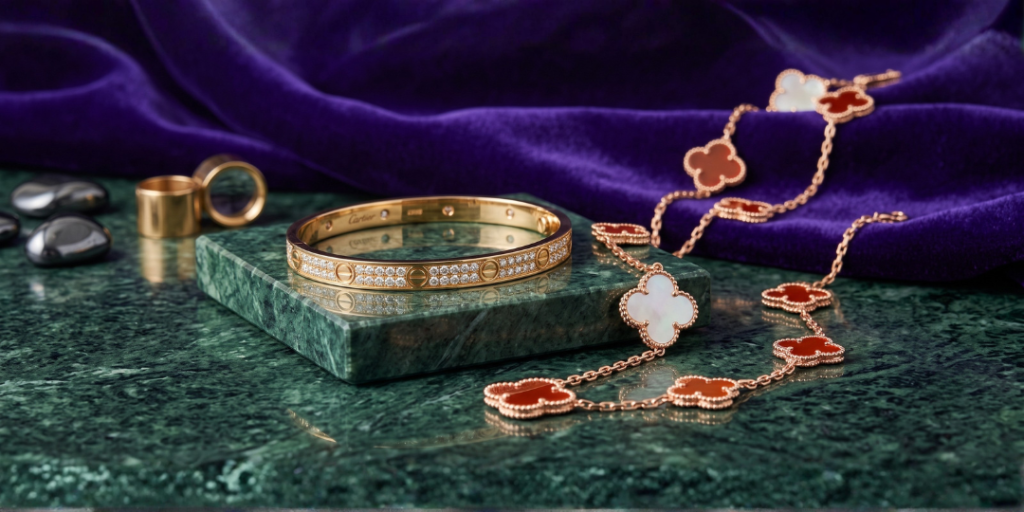
Ladies, if your jewellery box is filled with Van Cleef & Arpels Alhambra necklaces and Cartier Love bracelets, then you my friend, have impeccable taste in luxury. It’s clear that you appreciate fine craftsmanship, rich heritage, and pieces that tell stories across decades.
What you may not be aware of however, is that some of the most collectable Art Deco jewellery wasn’t made in gold or platinum, but instead made in none other than Bakelite! A type of early plastic that can have extraordinary properties in the right pair of hands.
So while a Cartier Love Bracelet is the pinnacle of gold craftsmanship, Bakelite jewellery is the pinnacle of Art Deco’s adventurous spirit, and despite first impressions, both came about in the same era, sharing that unmistakable geometric design language.
Consider this your luxury guide to all things in vintage Bakelite jewellery!
Well, it’s costume jewellery that’s made from phenolic resin. This was the world’s very first fully synthetic plastic, which was invented in 1907 by Dr Leo Baekeland, a Belgian chemist who was working in Yonkers, New York, at the time.
The chemistry behind it is a little more complex than you might be led to believe. Baekeland combined phenol with formaldehyde, creating a heat resistant, mouldable material which he coined ‘Bakelite’.
Immediately, it took the world by storm as it revolutionised industrial products such as black telephones, camera cases and electrical insulators. It had exactly what most materials in the industry needed; it was practical, durable and oh-so unglamorous.
It wasn’t until the 1920’s that designers quickly realised the aesthetic potential of Bakelite. It could be moulded into complex shapes, carved just like wood, dyed in vibrant colours and polished to a gorgeous sheen. By the 1930’s, Bakelite jewellery had become the ‘It Girl’ of the jewellery industry. cartier
In New York in 1927, the American Catalin Corporation introduced 15 new colours and trademarked them as Catalin. American designers began creating playful, jazzy pieces such as bangles with polka dots or laminated stripes and clips featuring animals and flowers. European designers approached it differently, producing discreet, geometric pieces influenced by Bauhaus aesthetics and Art Deco motifs borrowed from Egyptian, African, and Aztec design principles.
In 1925, vintage Bakelite jewellery was displayed at the Paris Exhibition alongside Lalique glass and Puiforcat silverware. Soon enough, luxury fashion houses such as Chanel incorporated it into their collections, and luxury stores such as Saks, Bonwit Teller, and B. Altman began selling it alongside traditional fine jewellery.
Like any luxury category, Bakelite jewellery also has tiers based on rarity, craftsmanship, and condition.
Certain colours are more expensive than others. Rare Bakelite jewellery colours include:
Deeply carved vintage Bakelite jewellery requires great skill that’s rarely come across. Intricate geometric patterns, florals and Art Deco motifs are a lot more expensive when compared to simple plain bangles.
Wide, heavily carved cuffs for example, take hours to produce and can be auctioned between £2,000 and £6,000.
It’s no surprise that pieces created by well-known designers always reach skyrocketing prices. For example, Bakelite designs from Chanel’s 1930’s collection are both exceptionally rare and highly valued. Coco Chanel was perhaps one of the very few luxury designers who truly understood the aesthetic quality of Bakelite.
Another example is that of Auguste Bonaz, a French designer who worked in Bonaz Studios in France between 1920 and 1930. Bonaz made exceptional pieces from both Bakelite and Galalite, all of which now reach thousands at auction.
Folks, we hate to tell you, but there’s a lot of fakes circulating in the market. Knowing how to identify genuine Bakelite jewellery is an art in itself and requires a series of tests. It’s worth noting that no single method works 100%, so you’ll have to combine a few to give you the complete, confident answer.
If you’re wondering how to identify vintage Bakelite jewellery most reliably, the hot water smell test is what you need to start with.
Immerse your jewellery pieces in hot, but not boiling water for around 15 to 30 seconds. Remove and smell it immediately. Real Bakelite will emit a particular smell of formaldehyde or phenol, that’s somewhat both sweet and chemical and may remind you of old telephones or medical supplies.
Once you identify that smell, it’s hardly likely you’ll forget it! Modern plastic simply doesn’t produce such smells.
Simichrome polish, also referred to as pink metal polish, reacts with Bakelite’s chemical composition. Take a small amount on a cotton swab and rub it on the inside of a bangle or the back of a brooch for about 30 seconds. Examine the swab and check for a yellowish or tobacco-brown staining which is a tell-tale sign of Bakelite.
A useful tip when carrying out this test, is to test on hidden areas since Simichrome may mark surfaces if you’re not careful.
Vintage Bakelite jewellery feels substantial and a lot heavier than modern plastic such as Lucite and even celluloid. If you pick up a Bakelite piece, get a sense of its weight in your hand. If it feels surprisingly light for its size, it’s most likely not Bakelite.
If you gently tap two Bakelite pieces together, you’ll hear a deep, clunky sound compared to modern plastic that sounds more brittle and higher pitched.
What About “Fakelite”?
Fakelite exists. Some pieces pass chemical tests but can fail the hot water smell test or vice versa. The best way to deal with this is to buy from only trusted dealers who can guarantee authenticity.
Bakelite vintage jewellery, much like most luxury pieces, requires gentle care. Yes, they’re incredibly durable, but that doesn’t mean they shouldn’t be treated with care.
For starters, you can clean these pieces with lukewarm water and mild dish soap. If you’re cleaning carved areas, make sure to use brushes with very soft bristles and rinse thoroughly. Make sure you dry these areas immediately and completely before storing the piece away.
To restore lustre, you can always apply thin layers of Renaissance Wax and buff it in gently. Simichrome polish restores shine, but use sparingly and on solid-coloured pieces only. It’s best to avoid using harsh chemicals, ammonia-based cleaners, or ultrasonic cleaners. These cause irreversible damage to your Bakelite pieces that you most definitely do not want!
Avoid storing these pieces in direct sunlight since the colours can fade pretty easily. Also keep away from heat sources such as radiators and heating vents, since excessive heat can cause warping or cracking.
Almost everyone owns a Cartier or a Van Cleef & Arpels piece. What’s the fun in that?
What Bakelite jewellery brings to the table is the bohemian side of luxury. It was the result of a bold decision to transform industrial plastic into Art Deco masterpieces.
Don’t get us wrong — we’re not hating on your VCA or Cartier pieces. If anything, we’re equally obsessed with them! But your VCA and Cartier will always be VCA and Cartier. Your Bakelite pieces, however, are discoveries waiting to be revealed. A story waiting to be told.
If you ask us, that’s what luxury really is.
Not ready to take the plunge into Bakelite waters just yet? Don’t worry! Check out our collection of Cartier and VCA pieces at Love Luxury. We have something for everyone!
 Know Your Jewellery: Cartier
 Cartier Jewellery That Is Worth the Price
 From Paris with Love: The History Behind Cartier
 Cartier’s Most Famous Jewellery Pieces That Every Woman Wants
 Luxury Cartier Items that Are Worth the Price
 Van Cleef & Arpels and Art – Examining the Connection Between VCA Jewellery and Art
 How To Sell Your Cartier Love Bracelet