
In 1837, when Thierry Hermès opened up his saddlery workshop, a saddle seam failure meant life or death.
Equipment that broke all of a sudden, mid-gallop, could quite literally mean disaster. A rider on the ground. A spooked horse. What could go wrong? Apparently, quite a lot.
The Hermès saddle stitch meant survival.
Two centuries later, the same hand-sewing method spells luxury today. Here’s everything you need to know about the iconic technique.
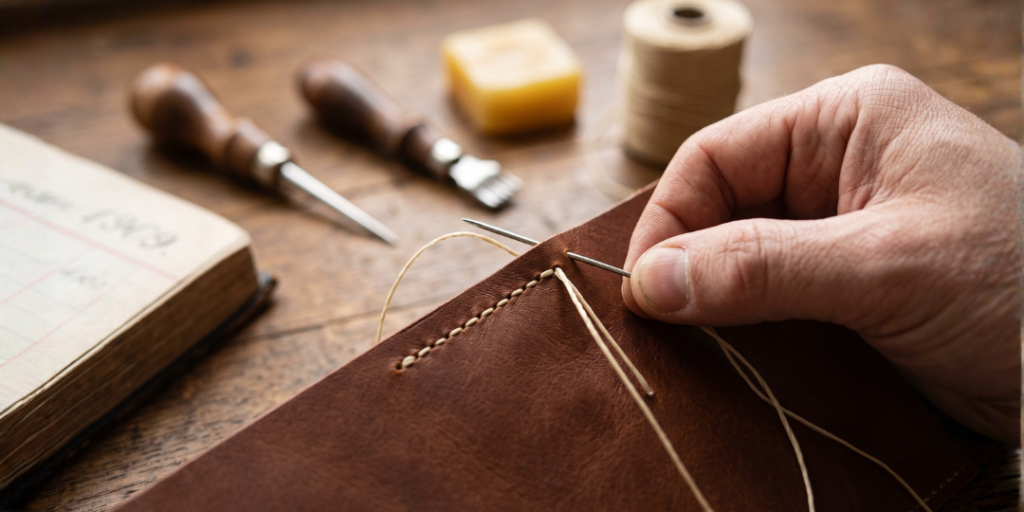
The saddle stitch Hermès is the technique that refuses to die, and it’s deceptively simple. Two needles, one thread, both passing through the same hole from opposite sides. That’s pretty much it, but it’s the technique that’s been stumping industrial engineers for decades.
Now, unlike machine stitching, which uses a single thread that’s locked by a bobbin, the Hermès double saddle stitch creates interlocking stitches that are independent. If one thread snaps, the rest holds firm, so no unravelling or zipper effect down your seam.
If machine stitching breaks down at any point, the whole thing can unravel and fall apart. If, however, a saddle stitch breaks down, you’d never notice. As important as the technique is, the thread itself is just as important. Hermès uses beeswax-coated linen, typically 0.6mm to 1.2mm thick. The beeswax strengthens the thread, prevents fraying, glides smoothly through the leather, and, most importantly, locks the stitch in a single place once pulled tight.
Every Hermès saddle stitch begins with an awl piercing angled holes through the leather. These holes sit at an 18-degree slant, which is the signature Hermès angle you can spot pretty easily if you know what to look for.
The awl is pushed through, then the first needle follows, and so does the second needle from the same hole, but this time from the opposite side. When the needles cross paths inside the leather, they’re pulled tightly and then moved to the next hole. This exact technique is repeated anywhere between 680 and several thousand times for larger pieces.
This sounds simple, but when leather thickness begins to vary and corners turn, the very act of maintaining concentration as the act is repeated is powerful in itself. The Hermès saddle stitch sits slightly raised on the leather, and it’s one of the simplest, yet most powerful giveaways of an authentic Hermès handbag.
Training someone to master the Hermès saddle stitch takes about two to four years. Let that sink in!
Leatherworkers typically arrive at Hermès, spending their initial weeks learning about the tools and then moving on to practising the saddle stitch Hermès technique. It can take years for leatherworkers’ work to meet Hermès standards for visible stitching. At Hermès’s internal training school, L’École Hermès des savoir-faire, around 200 apprentices train annually, and it can take up to a year to produce saleable work.
According to the Hermès Executive Chairman, Axel Dumas, the company uses Hermès saddle stitching because no machine can yet replicate the quality of the human hand. Contrary to popular romantic notions, Dumas said, “We are not a museum of craftsmanship,” which suggests that if better technology were to come around, they’d be willing to adopt it.
If you weren’t already aware, even a Birkin or Kelly only gets about 10-15% Hermès double saddle stitch. The rest is carried out with high-quality machine stitching, resulting in precision that means most people wouldn’t even be able to tell the difference.
You’ll notice the Hermes saddle stitch in certain places of the bag that require the most strength, such as the handles, main seams and stress points – basically everywhere those stitches will be visible and touched.
A single Hermes handbag takes about 40+ hours to make, from the first cut right to the last polish. With that sort of time going into a single piece, no wonder Hermès’ production is limited!
When Thierry Hermès first founded his company, he was most definitely NOT making handbags. In fact, he was making quite the opposite — saddles and harnesses for European carriage horses! His saddle stitch technique won first-class medals at the Exposition Universelle in 1867.
But when automobiles replaced horse-drawn carriages, Hermès pivoted from saddles to handbags. They applied the same saddle-making expertise to the luggage market. That’s when the Haut à Courroies bag was launched, a handbag originally designed for horsemen to carry their saddles and boots.
Then the 1930s rolled around, and Robert Dumas reimagined it as the Sac à Dépêches. Two decades later, Grace Kelly made it famous and thus the Kelly was born.
In 1981, when Jane Birkin complained about the functionality of a handbag to Jean-Louis Dumas on a flight, he sketched the Birkin on an aeroplane sick bag. While both bags were essentially different, they had the same foundation: Hermès saddle stitching techniques perfected on actual horse saddles in the 1800s.
That’s not to say Hermès doesn’t still make saddles. They do, incidentally. Around 400-500 annually, handcrafted in workshops above the flagship boutique at 24 rue du Faubourg Saint-Honoré. Yes, it’s the same building they’ve occupied since 1880.
Since 1909, every Hermès saddle has been registered in a ledger book: number, specifications, measurements, year manufactured, saddle-maker’s name, customer’s name. The oldest surviving book dates to 1909, though earlier records existed but were lost. That means, if you’ve inherited a saddle or bought one second-hand, you could contact Hermès and find out the saddle’s history, who made it and when. How cool!
When you know what to look for, getting scammed gets a whole lot harder. But that requires you to understand Hermès saddle stitching.
Here are a couple of dead giveaways that you need to take a closer look at:
Of course, none of this replaces a professional authentication, but it doesn’t hurt to know the difference between impeccable hand work and sloppy machine fakes!
If there’s one thing for sure, Hermès isn’t interested in mass production.
They could increase production, after all they’ve got the capital and the demand. But they won’t, because scaling Hermès saddle stitching isn’t exactly as easy as it sounds.
Their philosophy also plays out, since Hermès bags hold their value much better than any other luxury item. The Hermès saddle stitch isn’t some quaint holdover from simpler times. It’s a workman’s technique that dates back all the way to the 1830s.
Two needles, one thread, pre-punched holes, beeswax-coated linen, an 18-degree angle and execution that’s not replaceable by machines. That’s exactly why the Birkin takes anywhere between 18 and 24 hours to make, that’s why artisans train for years before they’re allowed to touch a bag, and that’s why the world swoons over the luxury house.
The saddle stitch Hermès is craftsmanship that refuses to be replaced.
 Unlocking the Mystery of Hermès Quota Bags
 Your Complete Guide to Hermès Travel Bags Because Regular Luggage is So… Regular
 How to Tell If Your Hermes Bag Is Real
 Best Place to Buy and Sell Hermès in London
 The Hermès Heritage Factor – Why Hand-Stitching Matters
 Harnesses to Handbags: The History of Hermès
 Everything You Should Know About Hermés Special Order [2026 Updated]