
Just a few years ago, buying a luxury watch meant you had to suffer through waitlists and record-breaking resale prices. Today, that frenzy is finally starting to take the backseat.
According to the Federation of the Swiss Watch Industry (FH), Swiss watch exports declined by 1.7% in 2025. This is the industry’s second consecutive year of contraction as consumers become more price-conscious every day.
This doesn’t mean that people are no longer interested in fine watchmaking; it just means the marketing is changing. Collectors are no longer falling for short-lived hype of modern, flashy watches. Instead, it’s all about originality, provenance, and long-term desire these days.
That’s exactly why seasoned collectors are now on the search for classy neo-vintage watches, which are references released between the 1980s and early 2000s.
The most popular brandsbrannds known for their neo-vintage pieces are Patek Phillippe and Rolex. Neo-vintage references such as the Rolex Zenith Daytona and Patek Philippe’s early Nautilus have become highly sought after by collectors in recent years. Keep reading to learn all about this new movement and what it means for collectors like you.
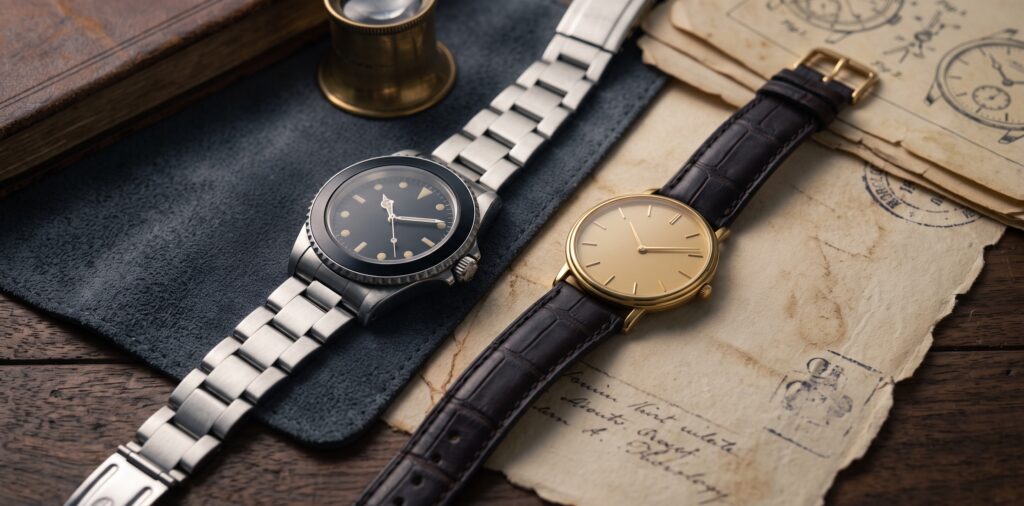
The term neo-vintage refers to watches made anywhere between the late 90s and the early 2000s. They’re just old enough to have collectible character, but too recent to be vintage and pricey.
This isn’t a legal or industry term to define a certain type of watch, just something collectors use to refer to the new wave of interest in 20 to 30-year-old watches. In terms of Rolex watches, “neo-vintage” can sometimes also refer to 5-digit references produced in the 80s–90s.
But why did this random era produce more likeable watches than other decades? It’s not random – the 80s–90s were a transition period after a quartz crisis. The popularity of mechanical watchmaking was on the rise, giving luxury watchmakers the bricks to lay the groundwork for the watch market we see today.
Neo-vintage watches tend to have the beauty and design of older models combined with the reliability of new watches. They also almost always feature one or more hallmarks loved by collectors. That includes details like slim bracelets, vintage dials, true tool-watch proportions, elegant case sizes, and more.
At the same time, you can expect them to feature modern conveniences like water resistance, service-friendly builds, sapphire crystals, and so on.
Rolex is a favourite among collectors looking for neo-vintage pieces. Four-digit Rolex watches are considered vintage, while six-digit references are too modern. Five-digit Rolex watches hit the perfect sweet spot for neo-vintage lovers.
This includes iconic references like the Explorer, Submariner, and GMT-Master.
Patek Philippe’s neo-vintage watches aren’t limited to certain references but more to their design evolution in that era. Collectors consider Patek Phillippe watches from the late 90s to the early 2000s “neo-vintage,” especially if the have classicclasic case shapes and traditional layouts. That includes watches like Calatravas and some other dress watches from that period.
The vintage Rolex vs. modern Rolex debate is changing.
Collectors are no longer falling for the short-lived hype of modern watches. Scarcity is no longer enough of a reason to invest in a watch – it must also be wearable, collectable, and valuable. Plus, it needs to be timeless, avoiding features like heavily polished finishes, oversized cases, and aggressive designs.
Modern hype watches are made to stand out visually, but that’s not a priority for the collectors of today. They actually prefer references that are simple enough for daily wear. They are spending a fortune on it, after all.
Interest in smaller, thinner, and overall plainer watches is on the rise, even on dress watches. Collectors now even prefer to stick to leather straps instead of large bracelets on sports watches.
More importantly, they don’t want overpolished cases because they take away from the originality and sharpness of the watch. Polishing a watch too much will blur the edges, soften its bezels, and make a watch look less honest. Resellers don’t want to invest in watches that may be mistaken for counterfeits and drive away sellers. Instead, they’re more willing to pay for watches with a crisp case geometry and intact finishing.
The hype cycle has also cooled down. After the pandemic-era surge, the secondary watch market corrected sharply, and the most fashionable models were hit hardest.
This was a much-needed change, as watches would be sold at ridiculous premiums simply because of the hype. Now that they are no longer being bought just for status and microtrends, watches only perform well if they have a strong design, rich history, and high practicality.
Collectors consider the Rolex 5-digit era the perfect “sweet spot” for neo-vintage pieces. These watches have all the usability of modern watches without giving up the old-world charm. This is true for references like the Rolex 5-digit Submariner, GMT-Master II, and Explorer II.
The appeal isn’t just about nostalgia for a long-gone era. Collectors simply appreciate the difference the difference in proportions, build feel, and relative value – details that simply don’t look the same in modern watches.
The size and shape of the 5-digit era are impeccable. Rolex 5-digit watches typically have slimmer cases and traditional layouts since they were released before the brand’s larger “super case” era. Plus, ceramic bezels weren’t created yet, so the watch was generally less bulky.
The Explorer II and GMT-Master II are perfect examples of this. The 5-digit version of the GMT-Master II still had the slim aluminium bezels that collectors still love today, instead of the ceramic ones in the later models.
Plus, collectors love the drilled lug holes, hollow centre links, and tritium dials on the 5-digit watches, all features you can’t find in modern references. These details give the watch a retro feel that’s still simple enough for daily wear.
The market has helped, too. In fact, 5-digit sports models are often among the least expensive options in their respective Rolex sports families, with Submariners commonly sitting around £1,500 to £2,200 below ceramic-bezel successors on the secondary market.
When you combine that price gap with the current wave of nostalgia for pre-ceramic Rolex watches, it makes complete sense that collectors are walking away from hype premiums and focusing on the five-digit era.
Patek Philippe has one of the best collections of neo-classics. These watches preserve the brand’s traditional dress watch design but still have a few later-era changes in usability, finish, and movement.
When talking about PP neo-vintage watches, collectors are usually referring to the slim Calatrava references from the 90s and 2000s. They’re definitely more modern than true vintage but way less flashy than the pieces you can find today.
But what makes the Calatrava so quintessentially neo-vintage? It’s mainly the proportions. This watch features a slim round case, simple lugs, and flat bezel. Today, it’s the reference point for what most people consider “neo-vintage.”
Patek Philippe’s ref. 96 introduced these proportions with its 31mm case and restrained build. It quickly became the template for these neo-classic dress watches.
There’s another aspect to the appeal behind neo-vintage watches: direct ownership. Owning Patek Philippe vintage complications has always been about quiet luxury rather than loud display. This, combined with the brand’s ownership registration policy, confirms that a neo-classic PP watch is something to be personally held, not casually traded.
Rolex and Patek Philippe collectors are perhaps the biggest subscribers of the “quiet luxury” philosophy. But what exactly does that mean, anyway?
Quiet luxury is the idea that brands should portray the value of their products via their materials and craftsmanship, not large or flashy logos. These two watchmakers are known for this philosophy, especially when it comes to their neo-classic references. When we think of quiet luxury watches, we think of Rolex and PP.
Neo-vintage watches fit that logic well because many were made before watch design became more aggressive and status-forward. They have thinner profiles, smaller diameters, and more restrained dial architecture.
Plus, these watches just have that “if you know, you know” quality that collectors love nowadays.
Neo-vintage watches have become some of the best investment watches from the 2000s. It’s mainly because the supply of the best examples is at an all-time low while demand is on the rise.
The age of the watch doesn’t matter so much as the condition. Well-preserved, full-set watches with sharp cases, original dials, and intact bracelets are very rare, but that’s exactly what gets you the big bucks.
Especially when it comes to the Rolex five-digit sports models, there is a serious shortage of top-condition pieces. This is especially true for references like the GMT-Master II 16710, Explorer II 16570, Submariner 16610, and Kermit 16610LV. At the same time, demand is only increasing.
This, in turn, supports pricing stability better than a hype-driven niche that depends on a narrow group of speculators. Modern hype cycles are vulnerable to fast reversals when sentiment changes, as seen in the post-pandemic correction across the watch market. Neo-vintage is different because it’s supported by design relevance, wearability, and a finite supply of original examples.
If you’re new to the world of neo-classics, you may not know what to keep in mind when buying one. Here are a few factors that can help you differentiate between an okay find and an incredible one.
Neo-vintage watches get most of their value from their condition and originality. It’s not just about looking good, but it also speaks to their consistency.
If you ask us, we’d warn that refinished dials, over-polished cases, swapped case backs, or movement changes can materially reduce desirability and value, especially on collectible Patek Philippe and Rolex references. Two watches of the same reference can diverge sharply in value depending on how they have aged.
For neo-vintage pieces, originality is even more important because these watches are old enough to have collectible identity but still young enough that many examples were serviced or polished heavily during their life. The best watches are the ones that still look and feel honest.
The service history of a watch should also affect your buying decision, but only when there’s full transparency. When you have a complete service record, you’ll be able to confirm whether the watch has been maintained properly during its lifetime.
Still, it doesn’t let you know whether the watch has had any replacements. If the dial, crown, hands, bezels, or bracelets have been replaced with non-original parts, the watch’s value can drop drastically. Unfortunately, original parts can have even more value than perfect mechanical freshness in most cases.
The highest-value examples are usually those with documented service history and clear disclosure of any replaced parts.
You’re a lot more likely to retain most of the resale value on your Rolex or Patek Philippe watch if it comes with the box and papers. In fact, the full set can add around 5–15% to the resale value of Patek Philippe watches in particular. The Certification of Origin is very important for this brand.
The reason this happens is because the official papers can get rid of any buyer uncertainty, so they’ll be willing to pay closer to the original amount. Of course, the box and papers doesn’t undo any damage or replacements the watch may have, but it at least confirms its authenticity.
There’s no doubt that a modern Rolex or Patek Philippe is still a great score for even a seasoned collector. However, the luxury watch market is entering a more mature phase. Long gone are the days of putting all your savings on a hype watch that will no longer have any value in three years.
Collectors are now seeking watches that have history, balanced proportions, unique builds, and lasting relevance. These are all the qualities that neo-vintage watches deliver in abundance. If you’re hoping to score such a reference for yourself, you can buy preloved is neo-vintage Rolex and collectable Patek Philippe watches on Love Luxury today.
 Swiss Made: The History Behind Patek Phillipe
 Top Patek Philippe Watches to Invest In
 Best Place to Buy and Sell Patek Philippe in London
 Patek Philippe Auction Records and Their Impact
 Patek Philippe and Celebrity Endorsements – A Cultural Phenomenon
 The Patek Philippe Nautilus in Pop Culture
 The Rarest Patek Philippe Nautilus Models and Their Stories