
Most flaws decrease value. A scratch on a Birkin, a chip in Baccarat crystal or a stain on a vintage Hermès silk, and suddenly, the value has diminished.
But what if we told you there’s something out there that defies that principle?
It’s none other than the Rolex ghost dial – the dial that created frenzy in the collectors’ world. Let’s have a look, shall we?
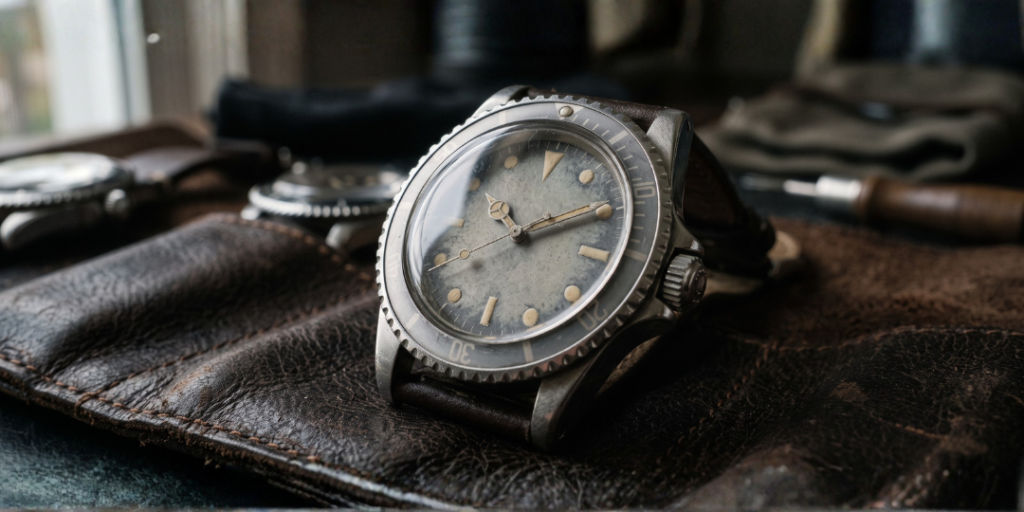
Before we get into it, let’s just clear the air and put it out there that this was a defect Rolex NEVER intended. The Rolex ghost bezel is what happens when the original dial colour fades over decades, creating a sort of ‘barely there’ appearance that makes the text and markers seem to ‘vanish’ into the dial background.
If you hold the watch at certain angles, you’ll be able to catch disappearing lettering, hence the ‘ghost’ concept. The effect is beautiful, haunting and a tad unpredictable. This phenomenon occurs exclusively on Rolex watches that were manufactured in the 1970s and 1980s. These were the eras when Rolex used organic paints and enamels that weren’t formulated for extreme longevity. Exposure to sunlight for prolonged periods of time, fluctations in temperature, humidity and general wear and tear cause these paints to fade in ways most modern dials don’t.
You’ll come across the Rolex Datejust ghost dial most frequently. White and silver Datejust dials from the 70s are known to develop this characteristic fade, with black text becoming progressively lighter until it’s barely distinguishable from the dial surface under certain lighting conditions.
The catch, however, is that every single ghost dial watch is unique. The fading process depends on how that particular watch has been used, since wearing habits directly affect the fading pattern.
The Rolex Submariner ghost bezel comes up a lot, especially on references 5513, 1680, and 16800, since these were the aluminium bezel models that were produced from the 1960s to the mid-1980s.
Submariner reference 5513, in particular, is of great significance. It was first introduced in 1962 and produced until 1989, representing one of the longest continuously manufactured references in all of Rolex’s history.
The Rolex GMT ghost bezel appears on the legendary reference 1675, which was produced from 1959 to 1980 with aluminium bezel inserts.
Finding a Pepsi bezel GMT-Master isn’t particularly rare, but finding a Pepsi GMT ghost bezel where both colours have faded into pastels is a whole different story. Dual-toned bezels have fascinating fading dynamics since the pigments respond entirely differently to UV exposure, saltwater and time. Some GMT bezels lose red pigments entirely, while the blue remains as vibrant as the day you got it. Other times, you’ll see a completely opposite pattern.
Some Rolex GMT ghost bezels even show what collectors refer to as ‘tropical’ transformation. The red aluminium transforms into fuchsia or magenta, instead of simply fading lighter.
The Rolex Datejust ghost dial is more accessible compared to the rest in this list. Datejust production numbers from the ‘70s and ‘80s exceed sport models, which means there’s a larger pool of potential ghost dial watches. White and silver dials are commonly preferred, since their ghost characteristics look impeccable as the black text fades progressively lighter over decades.
While Rolex Day Date ghost dials exist, they’re incredibly rare. A reason for this might be that Day-Date owners historically babied their watches more than Submariner or GMT-Master wearers – after all, Presidents weren’t diving and were spending a lot more time in climate-controlled offices and attending evening events.
The Rolex ghost dial Daytona is the absolute pinnacle of ghost dial collecting and possibly the most difficult to acquire.
Daytona production from the ghost dial era (1970s-1980s) was already limited compared to other Rolex lines. Finding vintage Daytonas at all requires patience, connections, and, dare we say, a whole lot of capital!
If you haven’t already guessed, the answer to this question lies in the economics of imperfection.
Logically, you’d assume that a damaged or faded Rolex watch would cost you less, but the Rolex ghost dial proves otherwise. These watches regularly get priced higher, sometimes even higher than non-ghosted ones.
Here’s why:
Caring for a ghost dial watch is a little trickier than caring for a regular Rolex watch you’d buy. While that fading is a direct result of how you use it, you could potentially destroy it if you’re not careful with your handling.
This sounds counterintuitive since your Rolex ghost dial quite literally got to its current state through UV exposure, but prolonged exposure could degrade the watch further, beyond collectors’ value. Yes, some fading is charming, but complete colour loss, where the bezels turn uniformly grey, isn’t what people are lining up for!
When servicing ghost dial Rolex watches, explicitly instruct the watchmaker NOT to refinish the dial or replace the bezel insert.
Some well-intentioned watchmakers will attempt to restore your watch to its original condition; they might refinish faded dials to crisp black text and install fresh bezel inserts in vivid colour. But what they’ve just done is destroy a highly valuable collectable while trying to help.
This goes without saying, but watch boxes and safes are meant for a reason, people! Store your watch away from humidity and extreme temperatures; silica gel packets can also help manage moisture.
These are vintage watches with aluminium bezels and aged dials. Wear them, but exercise judgment. Not for diving or for rough sports. Wear it occasionally to preserve movement health without risking damage.
Vintage Rolex watches are so highly sought after, mostly because the examples are either discontinued or extremely rare. However, what most people didn’t realise was that it was totally possible for ‘defects’ in a Rolex watch to transform into desirability!
The phenomenon of ghost dials and bezels indicates there’s a fundamental shift in how luxury markets value objects. Previously, we would have prized perfection, pristine and factory-fresh appearance above all else. Now, however, defects are seen as contemporary luxury. Patina, evidence of use and time, imperfections – they all tell stories that create a sense of uniqueness.
Do we expect the trend to die down any time soon? Probably not. Especially since the Rolex ghost dial and ghost bezel represent luxury at its most paradoxical.
Whether you’re considering a Rolex Datejust ghost dial as an entry point, pursuing a ghost bezel Submariner, or dreaming of a Rolex ghost dial Daytona, you’re acquiring more than a watch. You’re buying unrepeatable history, accidental beauty, and visible time.
We’ve got lots of Rolex watches – both brand-new and pre-loved, for you to explore and fall in love with! Check out our collection at Love Luxury!
 Rolex GMT-Master: The Traveller’s Companion
 4 Things to Consider When Buying a Rolex Datejust
 Why the Rolex Datejust Is a Must-Have for Watch Collectors
 Best Rolex Datejust Models for First-Time Buyers
 Why the GMT Master II Is a Favourite Among Pilots and Travellers
 Exclusive Platinum Rolex Datejust 178296 Model Review
 Discover the Perfect Everyday Rolex